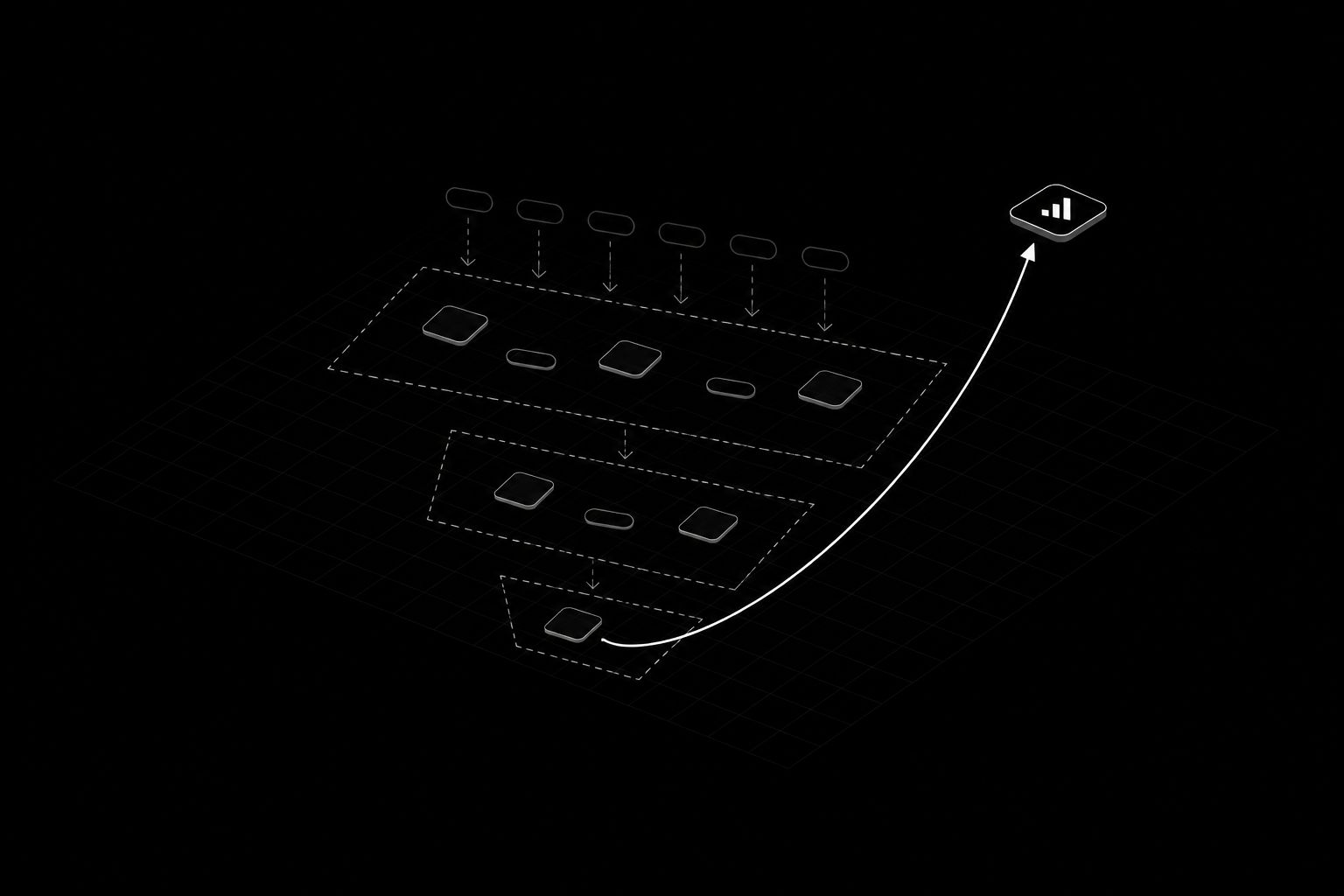
Marketing & Growth is more than running campaigns. It is about turning attention into movement and reach into actual results.
We treat performance marketing, conversion optimisation, funnel building and analytics as one connected system. Strong campaigns achieve little if landing pages do not convert. Good funnels help little if tracking cannot support a decision. And analytics helps little if no priorities come out of it.
The most expensive mistake: sending budget to a homepage
The most common reason for poor campaign results is not the ad but the destination. Paying for a specific search term and then landing people on the homepage loses a large share of those clicks in the first seconds — the ad promised something the page does not immediately deliver.
So we build the landing page first and the campaign second. One page per offer and search intent, in the same language as the ad, with one clear action and no distraction from a full main navigation.
This is unspectacular and usually moves more than any bid tuning: at the same budget and the same ad, the landing page decides how many clicks become enquiries at all.
Google Ads: buying intent, not reach
On search we buy intent rather than attention. That means tight, thematically clean ad groups instead of one account with a single group for everything. Negative keywords from day one, so budget does not drain into research queries that never become enquiries. Ad copy that picks up the query rather than listing generic virtues.
What you optimise towards matters. An account optimising for clicks delivers clicks. So conversion tracking has to be in place before the first campaign — measuring the step that actually earns you money, not a thank-you page view that a reload also triggers.
Meta Ads: for demand that does not exist yet
Nobody searches for you on Meta. The job is to describe a problem well enough that someone recognises themselves in it who was not looking for a solution at all.
That needs different material: creative that works in a feed rather than in a deck, several variants instead of one perfect execution, and a statement that arrives before the logo. We produce in short cycles and let results decide which direction gets budget.
For retargeting and audiences the same applies as for tracking: without server-side handoff and clean consent handling, the data is patchy and the platform optimises against an incomplete picture.
Conversion optimisation: where people actually drop out
Optimisation starts with finding where prospects are lost — not with a list of generic best practices. We look at the path from click to enquiry: which pages get reached, where it breaks off, how far people get into the form, what happens differently on a phone than on a desktop.
The findings are usually unglamorous and effective: a form with eight fields where three are needed. A pricing question answered nowhere, which is why people leave. A load time that ends every second mobile session before content appears.
If the focus is squarely on paid channels and measurable lead generation, the long-form version of this lives on our performance marketing page.
We prioritise by expected impact and effort — and test where there is enough volume to support a conclusion. At low traffic, an A/B test is not insight but coincidence with decimal places.
Reporting that triggers a decision
A report showing impressions and clicks answers no question you actually have. What matters is what an enquiry cost, which channel produced it, and whether it turned into work.
For that, the chain has to close into the CRM. We set the handoffs up so a won enquiry can be traced back to its source — otherwise you optimise for leads instead of revenue, and the cheapest leads are reliably the worst ones.
Typical work in this area:
- Performance marketing for ads and campaign logic
- Conversion optimisation for pages and processes
- Funnel building for lead and sales paths
- Campaign reporting with clear next steps

