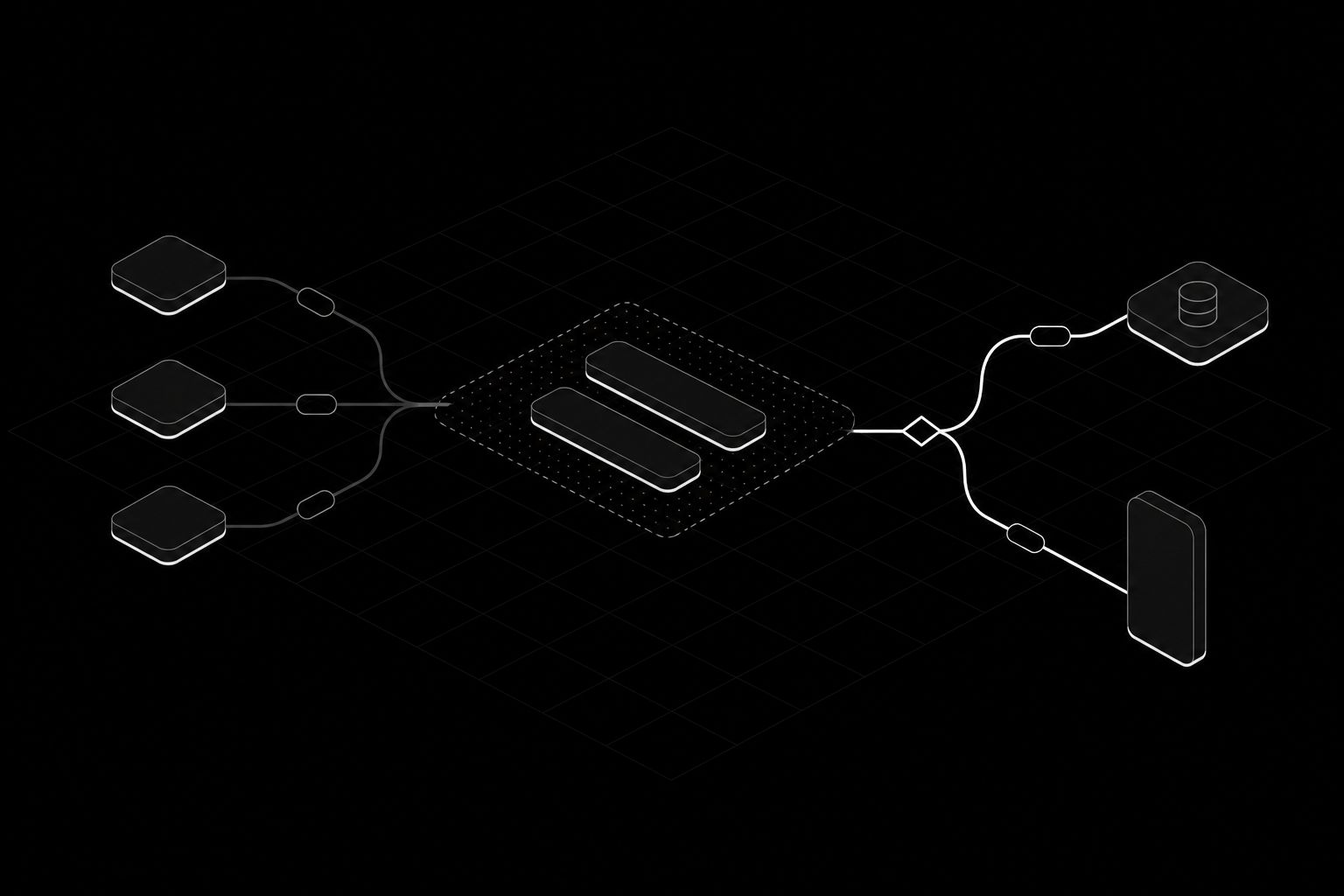
Automation & Systems becomes valuable when processes are not merely connected technically but genuinely relieved operationally.
We look at where work happens twice, where information gets lost, and where teams lose pace through poor handoffs. From that we build systems in which workflow automation, CRM and funnel automations, integrations and AI automations work together cleanly.
Process first, tool second
Most failed automations share one origin: a tool was introduced before the process was understood. The automation then encodes a workflow that was already broken — only faster, and with more people unable to intervene.
So we walk the real process first, with the people who run it daily. Where does an enquiry arrive? Who sees it first? What happens when someone is on holiday? At which point does something get typed by hand into a second system?
Double entry is almost always the most expensive point — and usually the easiest one to fix first.
Automating also means removing
Not every manual step deserves automating. A step that happens twice a month and takes thirty seconds does not justify an integration that has to be maintained forever. Sometimes the right answer is to drop the step or remove a form field rather than automate its processing.
We work that out openly: how often does it happen, how long does it take, what does the automation cost to build and to run? Where it does not pay for itself, we say so.
CRM and funnel automations
The typical gap sits between website and sales. A form gets submitted, an email lands in an inbox, and from there everything depends on somebody remembering. The source of the enquiry is usually already lost at that point.
We close that path: the enquiry goes into the CRM with its campaign data attached, is assigned by traceable rules, triggers a confirmation to the person who wrote in and a task with a deadline for the team. If nothing has happened after a defined interval, the system reminds — a person, not the void.
That includes follow-up sequences triggered by behaviour rather than by calendar, and proper handling of consent: what counts legally as marketing needs a basis, and we document it alongside.
Integrations: webhook before middleware
Zapier and similar services are good for testing an idea quickly. At volume they get expensive and opaque — and when something fails, nobody can see what went wrong.
So we go straight to APIs and webhooks wherever a process is business-critical or runs often. With retries on failure, with a log a human can read, and with an alert when something stays stuck. A silent automation that has not run for three weeks is worse than none at all.
AI automations: useful in preparation, risky at the point of release
Language models are strong at condensing, pre-sorting and drafting. They are weak anywhere an answer goes out unchecked.
We use them accordingly: summarising research, pre-classifying incoming enquiries, drafting recurring replies, turning meeting notes into tasks. The last step before the customer stays with a person. Where personal data is involved, we settle in advance which provider processes what and where, and what belongs in your record of processing activities.
What you end up with
Not a dashboard, but recovered time at specific points: less manual re-entry, faster response to enquiries, fewer things falling through when somebody is off sick.
Typical work in this area:
- Workflow automation for recurring processes
- CRM and funnel automations for lead and sales paths
- Integrations with Zapier, APIs and webhooks
- AI automations for research, content and assistive processes

